An AI agent can pass every pre-launch review and still encounter something new on Tuesday morning.
A clinic changes an instruction. A transfer destination stops answering. A caller asks for an exception the workflow does not cover. A system returns an unexpected response. A technically correct answer leaves the patient unsure what to do next.
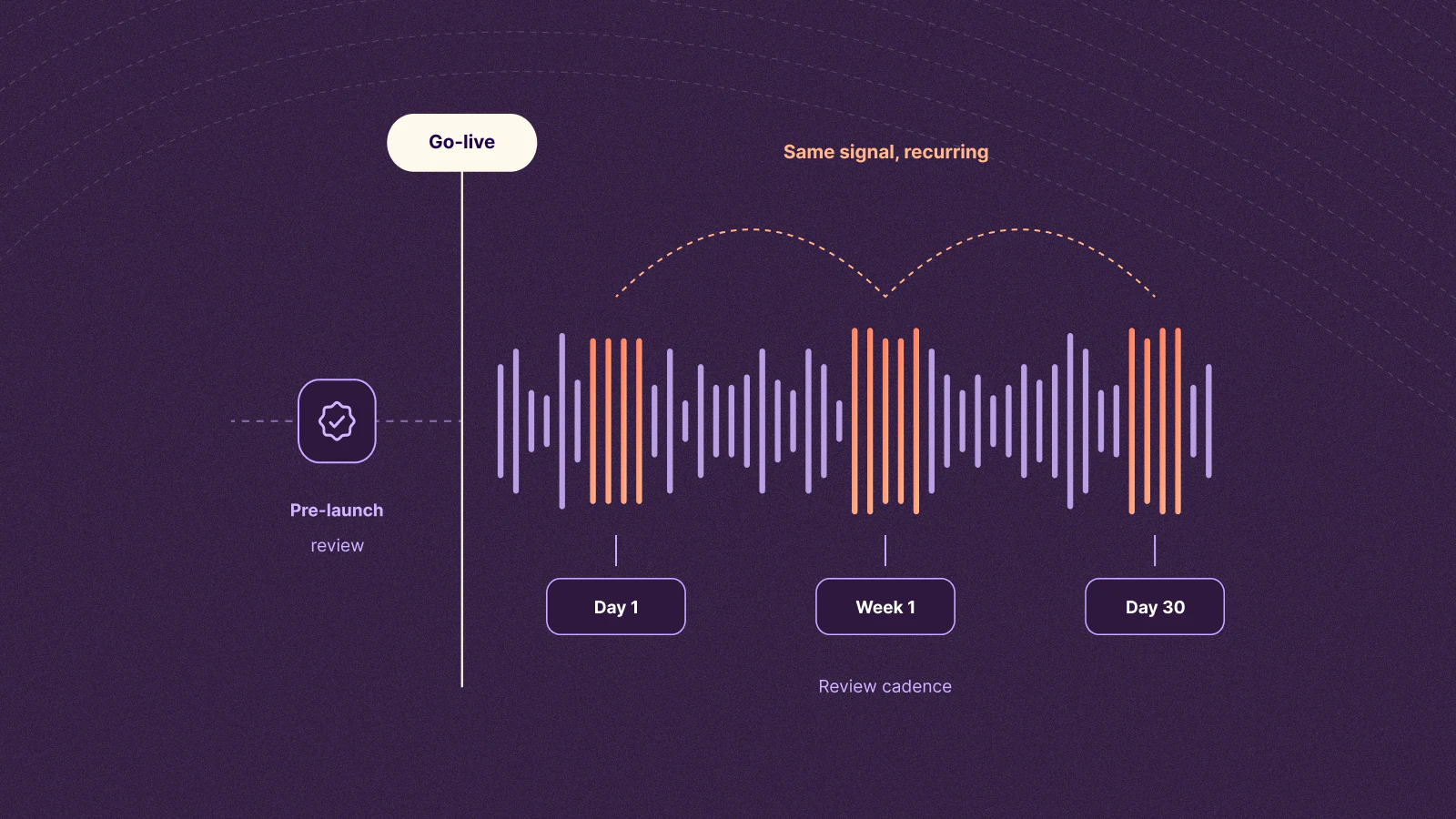
Go-live approval cannot settle those questions in advance. Governance continues in the evidence collected after deployment.
The operating questions begin after launch
Pre-launch review should establish scope, policy, testing, escalation, privacy, security, and ownership. It answers whether the workflow is ready to begin handling real interactions.
Post-launch review asks whether it is doing the job under real conditions:
- Did the AI agent understand the patient's intent?
- Did it provide accurate information within its approved scope?
- Did it complete the required work or explain the next step?
- Did it route to the right person when human judgment was needed?
- Did frustration, repetition, or confusion appear in the conversation?
- Can the team reconstruct what happened and act on a recurring issue?
These are operational questions. They need interaction evidence, a review cadence, and a named owner.
Start with the intended job
Governance becomes vague when the unit of review is simply “the AI.” A patient-access workflow gives the review a concrete boundary.
Take an appointment rescheduling agent. Its intended job may include confirming the patient's request, finding eligible appointments, completing the change, and transferring defined exceptions. That produces reviewable steps:
- Intent understood.
- Eligibility and policy followed.
- Appointment changed or exception escalated.
- Patient told what happened next.
- Interaction evidence retained for authorized review.
The team can then define what counts as successful completion, appropriate escalation, and material failure. It can also define what the agent must never attempt.
Without that workflow-level definition, a governance dashboard may collect activity without showing whether the patient reached the right outcome.
Review the interaction, the result, and the handoff
A reliable oversight process looks at three connected layers.
What happened in the conversation
Review the detected intent, information provided, questions asked, complaint or frustration signals, and points where the patient repeated or corrected the request.
What happened in the workflow
Confirm whether the work was completed, left unresolved, or moved to another person or system. A polite interaction can still end with the wrong operational result.
What happened after escalation
Check whether the handoff reached a valid destination, carried enough context, and gave the patient a clear next step. Escalation is part of the design. It is not a failure by default.
This last layer is easy to miss. An AI agent may correctly recognize that it should stop. The patient still needs the rest of the path to work.
Match the review cadence to the risk
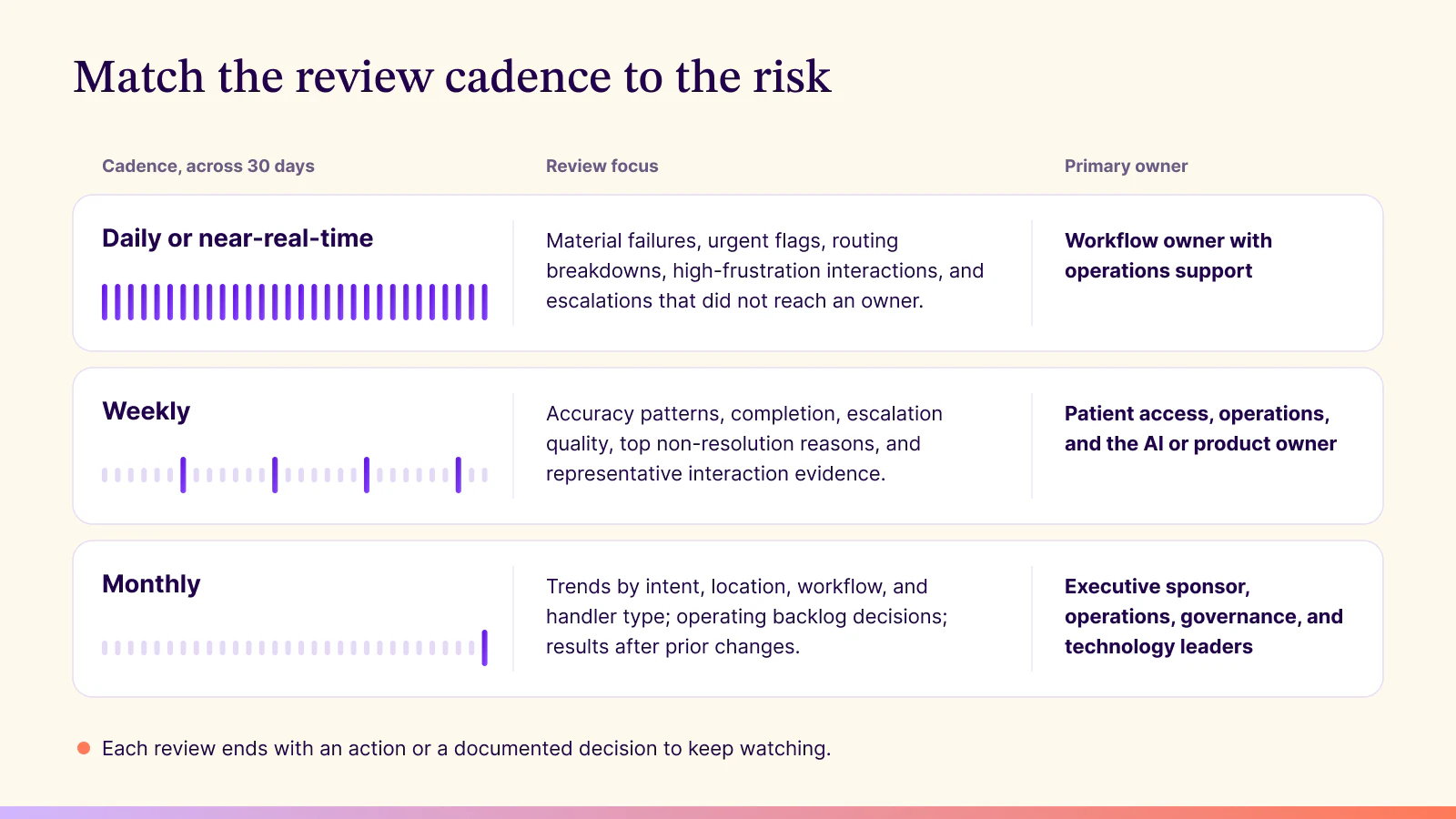
Not every issue belongs in the same meeting. A simple cadence keeps urgent failures visible while reserving trend work for the people who can change the operation.
Daily or near-real-time
- Review focus: Material failures, urgent flags, routing breakdowns, high-frustration interactions, and escalations that did not reach an owner.
- Primary owner: Workflow owner with operations support.
Weekly
- Review focus: Accuracy patterns, completion, escalation quality, top non-resolution reasons, and representative interaction evidence.
- Primary owner: Patient access, operations, and the AI or product owner.
Monthly
- Review focus: Trends by intent, location, workflow, and handler type; operating backlog decisions; results after prior changes.
- Primary owner: Executive sponsor, operations, governance, and technology leaders.
The exact cadence should follow the workflow's risk, volume, and escalation requirements. The important part is that each review produces an action or a documented decision to keep watching.
When a recurring issue appears
Suppose the analysis finds repeated confusion after an appointment change. Several patients ask the same follow-up question. The agent completes the transaction, yet the closing explanation is not landing.
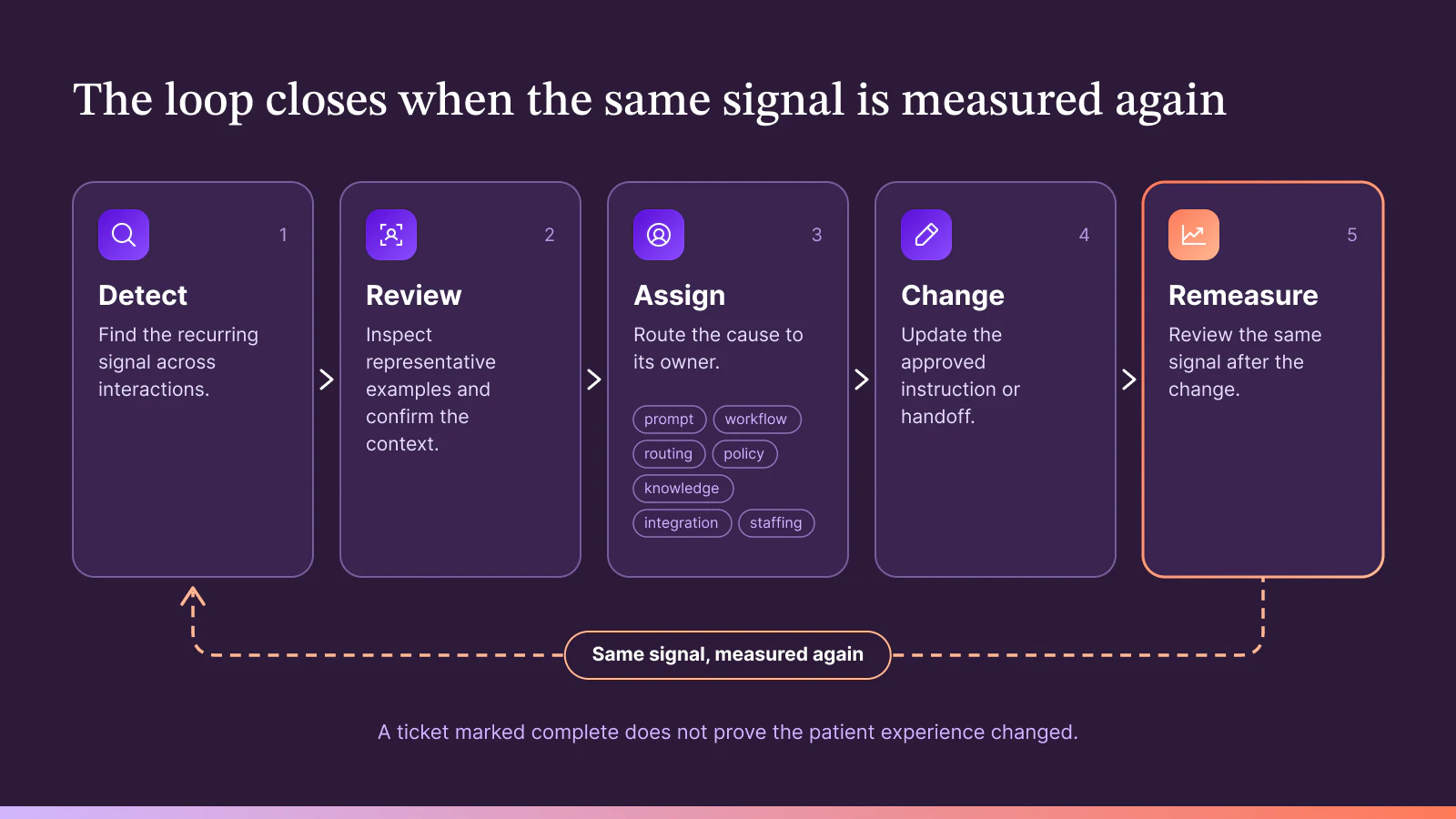
The investigation should be simple enough to repeat:
- Detect the recurring signal across interactions.
- Review representative examples and confirm the context.
- Assign the cause to the right owner: prompt, workflow, routing, policy, knowledge, integration, or staffing.
- Change the approved instruction or handoff.
- Review the same signal after the change.
That last step closes the loop. A ticket marked complete does not prove the patient experience changed.
Evidence should support judgment, not replace it
Automated analysis can scan recorded interactions consistently and surface patterns that merit attention. It can also be wrong. Transcription, classification, and scoring require testing against the language, workflows, and standards of the healthcare organization.
Human reviewers remain responsible for:
- defining the approved workflow and its boundaries
- testing whether the configured measures match policy
- inspecting representative calls and exceptions
- deciding what rises to a material issue
- approving changes to information, routing, and escalation
- documenting the result
Visibility grows with autonomy because responsibility stays with people.
Where interaction evidence fits, and where it does not
ActiumHealth offers patient interaction analytics through Insights Analytics for continuous analysis of recorded interactions, dashboards, trend reporting, QA scorecards, configurable standards, issue detection, complaint tracking, and summarization. In a patient-access AI workflow, those capabilities can support review of intent, resolution, non-resolution reasons, transfers, frustration signals, and follow-through.
That is an operational evidence layer for patient interactions.
It is not a complete enterprise AI-governance program. It does not replace clinical safety review, privacy and security controls, model-risk policy, legal review, or the broader governance work required across every AI use case.
The scope should stay clear. Good governance begins with knowing exactly which job a piece of evidence can support.
The question to settle before go-live
Before approving an AI agent for patient access, ask the team to name the evidence it expects to review 30 days later.
Who will see it? Which conditions trigger immediate review? Who can change the workflow? When will the same issue be measured again?
If those answers do not exist, the go-live plan is missing its operating half.