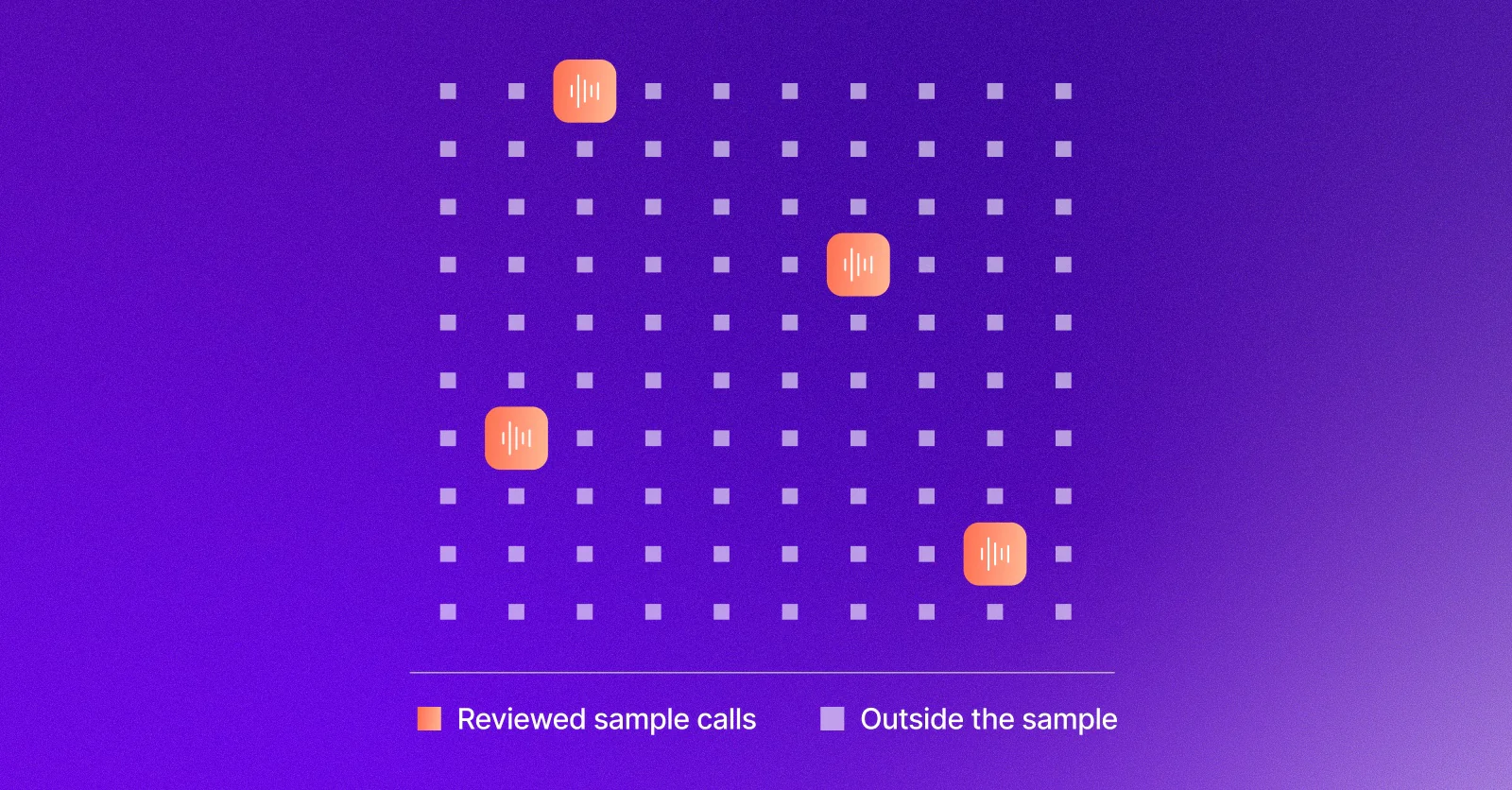
Healthcare contact center leaders are often forced to evaluate performance using only a small sample of calls. Consider a review based on four calls. Those four can tell four useful stories.
One may reveal a confusing script. Another may expose a routing error. A third may give a coach a precise moment to discuss with a patient access team member.
That work matters. The problem starts when those four calls are asked to represent the operation. To put the sample in perspective, if a contact center receives 1,000 calls in a day, four reviewed calls represent just 0.4% of that day’s volume. At 10,000 calls, they represent 0.04%. In either case, more than 99% of patient interactions remain outside the review.
A selected call can explain what happened in that interaction. It cannot reliably show how often the same problem occurs, where it concentrates, or who can fix it. Those are pattern questions. They require a broader evidence base.
The sample is answering a different question
In a common manual call center quality assurance (QA) workflow, a reviewer listens to a handful of call recordings selected at random, applies a rubric, records a score, and gives feedback. That process can answer questions such as:
- Did the interaction follow the approved script?
- Was the information accurate?
- Did the team member handle the caller with care?
- Was the next step explained clearly?
Operations leaders usually need another set of answers as well:
- How often does this scheduling barrier appear?
- Does it affect one location or several?
- Are repeated transfers tied to a certain patient intent?
- Is a complaint caused by individual behavior, or by the workflow every team member must follow?
- Which issue deserves attention first?
Listening closely and seeing broadly are different jobs. A strong quality program needs both.
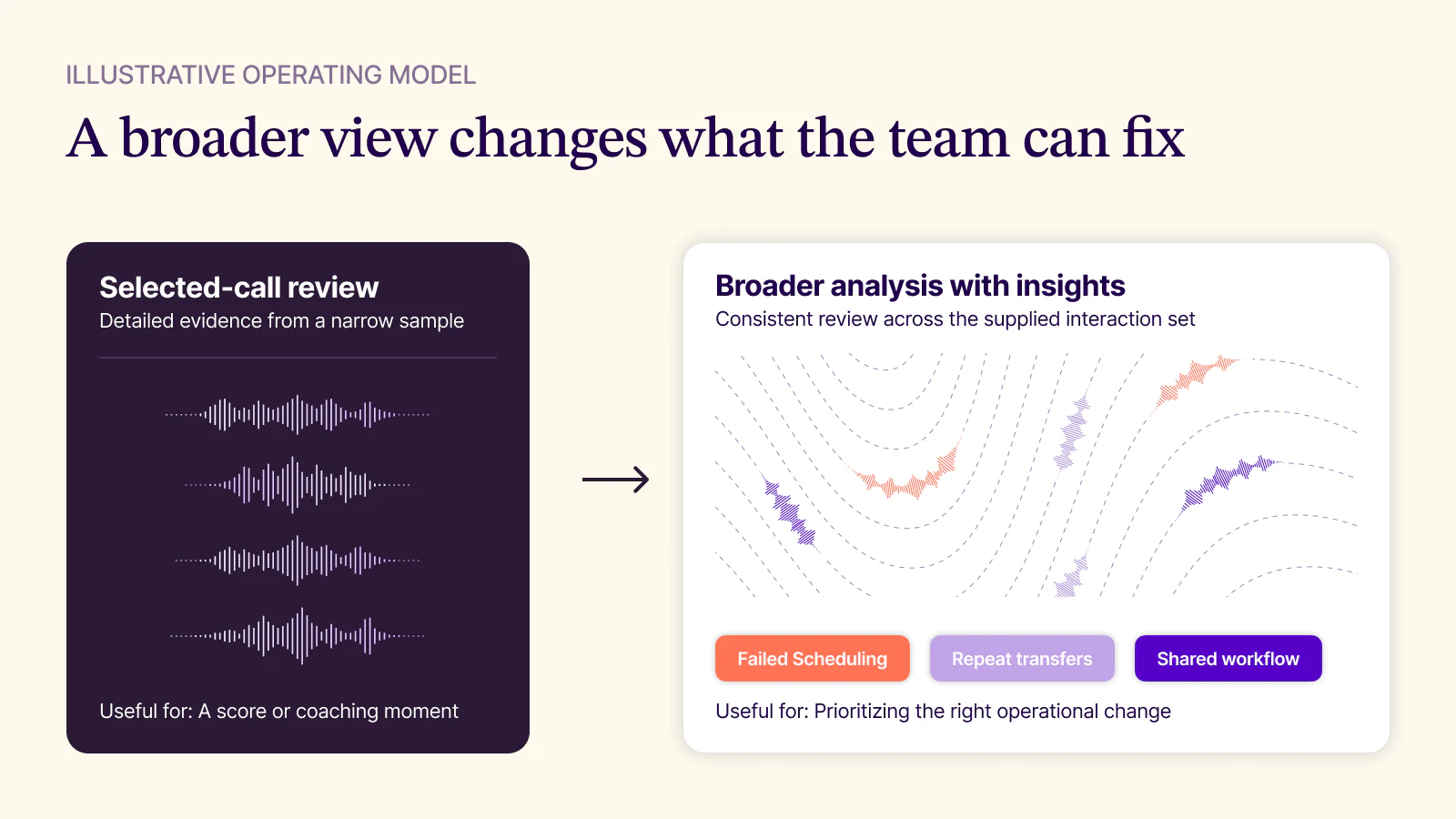
One call can be an exception. Repetition changes the diagnosis.
Consider an unsuccessful appointment request. In one reviewed call, the patient may have declined the available time. The outcome could look like patient choice.
Across a larger interaction set, the same service line may show a repeated sequence: no suitable appointment, transfer to another queue, voicemail, and no clear follow-up owner. Now the issue looks different. It may belong to template availability, routing, or the follow-up process.
The distinction affects what happens next and what the healthcare organization spends to address it.
Coaching the person who happened to answer the sampled call will not change a shared routing rule. Adding staff will not fix instructions that send patients to the wrong queue. Automating an unstable workflow may simply repeat the same miss at greater volume.
The cost of staying with a narrow sample is not simply having less information. It is time and budget spent on the wrong intervention while failed scheduling, repeat transfers, avoidable work, and patient frustration continue.
Healthcare contact center analytics gives leaders a broader evidence base for determining how often an issue occurs, where it concentrates, which patients and workflows it affects, and who can act. That helps the team direct coaching, staffing, process improvement, and automation toward the actual cause.
- Failed scheduling: A narrow sample can make failed scheduling look like an isolated patient choice. Insights can group recurring non-resolution reasons by location, service line, or workflow, helping teams target availability, routing, or follow-up problems and protect visit opportunities.
- Transfers: A few transfer examples may appear reasonable on their own. Insights can find repeated transfer paths by patient intent, destination, and outcome, helping reduce avoidable handoffs, repeated work, and patient frustration.
- Coaching: Decisions based on a handful of interactions can miss whether the cause is individual behavior or a shared script, policy, or process. Broader evidence supports fairer coaching and assigns system issues to the team that can fix them.
- Complaints: Complaints can appear as unrelated anecdotes. Insights can show which complaints repeat and where they concentrate, helping leaders prioritize those posing the greatest patient and system risk.
- Improvement priorities: A narrow sample can allow the loudest escalation to set the agenda. Comparing frequency, patient impact, operational ownership, and ability to act helps focus staff time and budget where a change can have the greatest effect.
Broader evidence should improve the system, not just score staff
Analyzing more interactions does not remove judgment. It extends judgment across a broader evidence base, giving leaders more confidence to assess patterns a small sample could not reveal. It also helps teams track whether process, staffing, or training changes reduce the problem over time.
Instead of spending most review time searching for representative calls, a team can use Insights to find a recurring signal across a broader interaction set. Reviewers then inspect real examples, test the classification, and add the operational context only they can provide.
That context matters. A non-resolution may be appropriate because the request required clinical judgment. A transfer may be correct because policy places the next step with another department. A longer interaction may reflect good service for a complex need.
Insights provides a jumping-off point for the investigation. The model surfaces the pattern; human reviewers determine what it means and what should happen next.
Broader conversation analysis should not turn every interaction into a personnel judgment. Scripts, scheduling access, queue design, escalation policy, staffing, and unclear ownership all shape what happens. A fair review starts with the workflow:
- Find a repeated interaction pattern.
- Review representative calls and confirm the context.
- Decide whether the cause is training, routing, policy, staffing, system access, or workflow design.
- Assign the issue to the team that can change it.
- Measure the same pattern after the change.
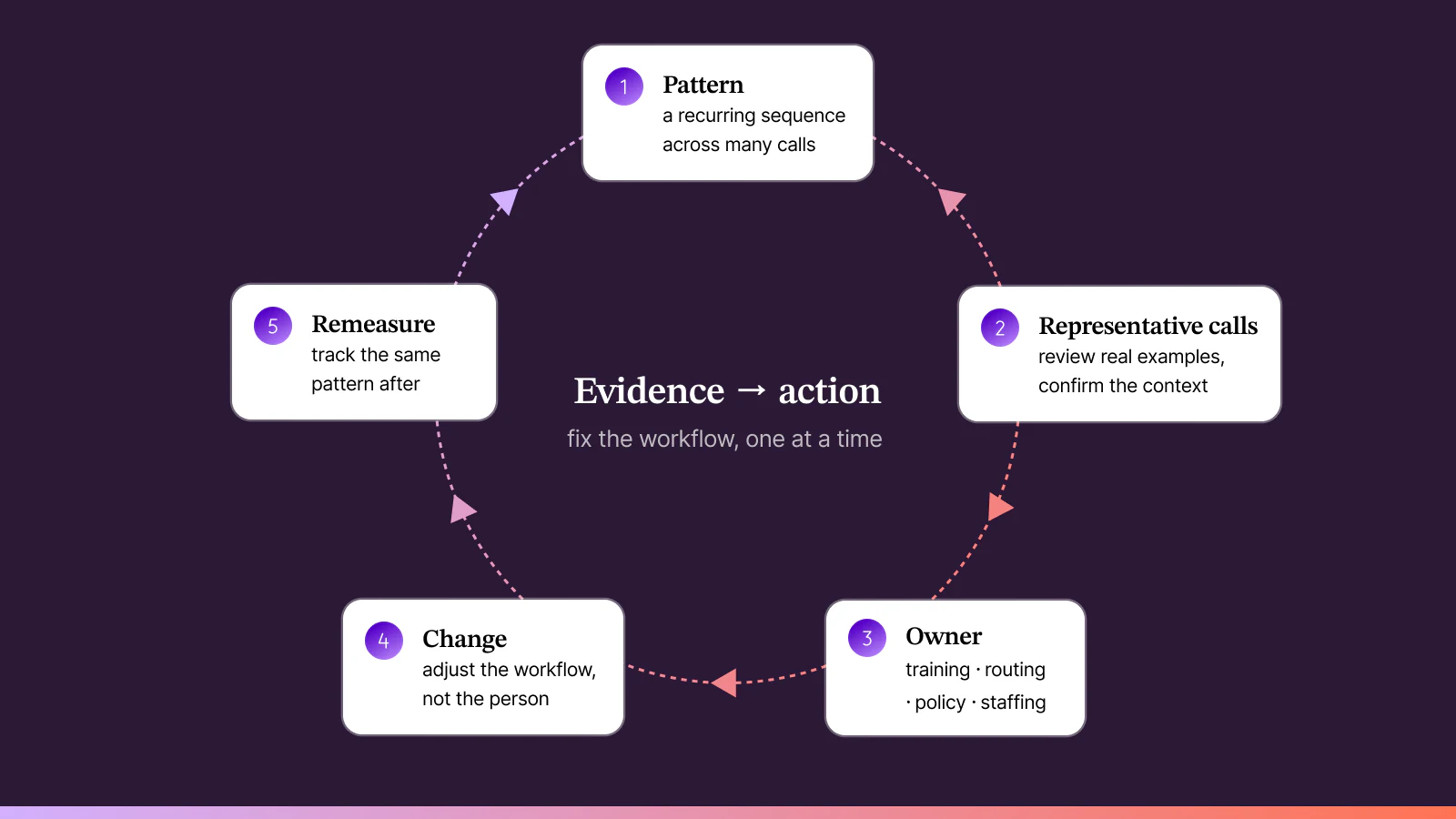
The individual interaction remains important. It becomes evidence inside a larger operational picture, not a verdict on its own. That is fairer for staff and more useful for operators.
Three ways Actium Insights supports the work
Actium Insights gives contact center leaders three ways to understand their patient interactions:
- Insights Discovery delivers a one-time analysis of your recorded calls that pinpoints where callers get stuck, patient leakage, unresolved calls, complaints, and the highest-impact opportunities for improvement.
- Insights Analytics provides continuous QA across your human contact-center conversations: consistent scorecards for every call, dashboards, coaching insights, and trend reporting by department, team, and agent.
- Insights Monitoring provides ongoing oversight of your AI-agent conversations, verifying accuracy, follow-through, routing, and compliance, surfacing caller frustration, and confirming which calls were issue-free.
Depending on the configured use case, the analysis can include caller type, intent, summary, resolution, non-resolution reason, complaints, transfers, and voicemail.
The useful outcome is not a bigger pile of scores. It is a shorter path from a recurring patient-access problem to the right decision.
Start with one decision the current sample cannot support
List the questions the current call sample answers well. Then list the decisions leaders still make from anecdotes, escalations, or incomplete reports. The gap between those lists is the case for broader analysis.
Start with one workflow in the patient access center. Scheduling, prescription refills, department routing, and general information requests are useful places to look because the intent and next step can be defined clearly.
Then ask one precise question: Is the current QA sample large and representative enough to show the repeated reason patients do not reach resolution?
If the answer is unclear, review is producing examples. The operation still needs the pattern.