The front door to your healthcare system is often a phone call, yet many call centers operate with technology and approaches that haven't fundamentally changed in decades. From handling an overwhelming volume of calls to addressing patient concerns efficiently, healthcare organizations are under pressure to optimize and update their operations.
AI agents offer a promising solution, but where should you focus your automation efforts for the biggest impact? In this report, we examine the current state of healthcare call centers, their pain points, and provide a framework to identify where AI can provide the most value, either by adding capacity, reducing costs, or driving revenue.
The Current State of Healthcare Call Centers
Healthcare call centers often struggle with several critical issues:
- Black box on caller experience: Spam calls, abandoned calls, and staff burnout are common challenges. There's often no visibility into what callers are calling about or their experience. On average, health systems resolve only ~41% of calls, meaning nearly 6 in 10 callers are left with a poor patient experience.
- Scaling issues: Healthcare call centers cannot scale up and down to meet fluctuating demand. This results in either overstaffing, which leads to higher cost, or understaffing, which leads to missed appointments and unresolved issues. Call centers experience churn that varies from 20% to over 100% every year.
- Inconsistent quality: Even when calls are resolved, quality can vary widely. With the ability to audit only 1-2 calls per agent monthly, understanding true performance is difficult. Agents can't be expected to speak every patient's language or be available 24/7.
- Reactive with undone work: Many tasks never even get started. Teams are so busy staying above water that there's no opportunity to proactively reach out to patients who need the most support.
AI's Role in Communication
Healthcare enterprises operate at a complex intersection of patients, vendors, and a large employee base. Millions of touchpoints, mostly handled by people, can lead to poor experiences, burnout, and inefficiency. This complexity highlights the need for strategic AI implementation.
AI can enhance communication in healthcare call centers by scaling human connection. Thanks to advances in AI and the increasing performance of large language models, it might seem like you can use AI everywhere, but what matters is not where you can, but where you should.
Step 1: Figure out what type of investment you're going to make
Before implementing AI agents in your healthcare call center, determine your strategic approach to automation. Your investment choice will impact implementation timelines, training needs, and expected ROI. Healthcare organizations typically pursue one of three strategies with AI agents, each offering different benefits:
- Augment: AI agents support staff with their work.
- Delegate: AI agents take on a subset of staff work.
- Expand: AI agents do work that was not possible or didn't make sense for staff to do.
Examples of AI agent workflows for each type of workflow and user group:
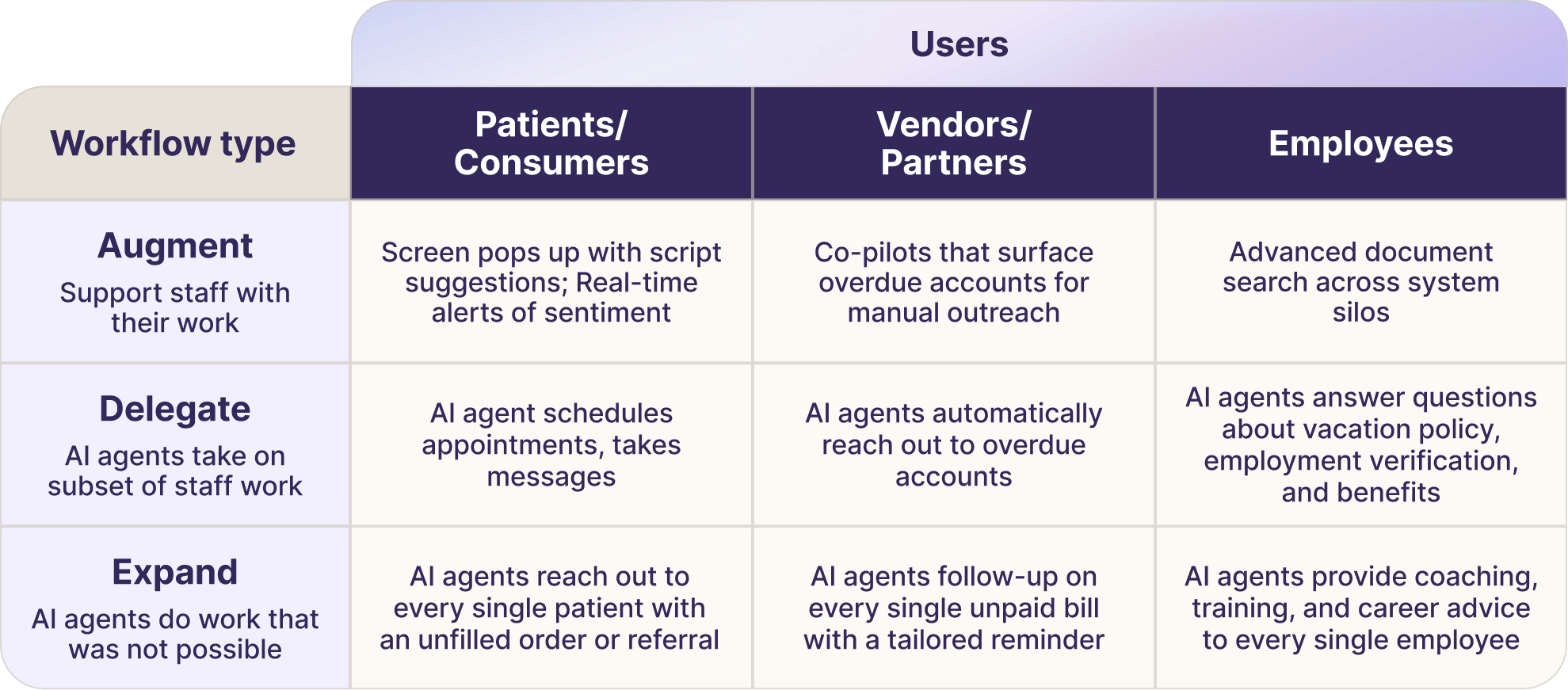
Augment workflows might seem attractive initially because you already have staff in place and want to make them more productive. As we'll see in the next section, however, the business case may not make sense compared to Delegate and Expand workflows.
Step 2: Think about the business case
Typically, organizations we work with think about the value in the following way, organized by care gap closures, revenue gains, and cost savings:
- Care gap closures: The number of tasks that have an opportunity to generate a care gap closure (e.g., CT lung screening), the share that result in that closure, and the value of that closure (e.g., DALYs, QALYs) or reimbursement, expressed in dollars to compare against investment.
- Revenue gains: The number of tasks that can generate revenue (e.g., calls about open orders), the share that result in a revenue-generating event (e.g., appointments booked), and the value of that event in dollars (e.g., revenue per appointment).
- Cost savings: The number of tasks deflected from staff, the number of equivalent tasks staff complete over time, total staff time saved, and the dollar value of that time using benchmark pay rates (usually $75k per year fully loaded).
As you analyze the value and cost to buy and deploy the solution, you'll notice different dynamics across the three approaches:
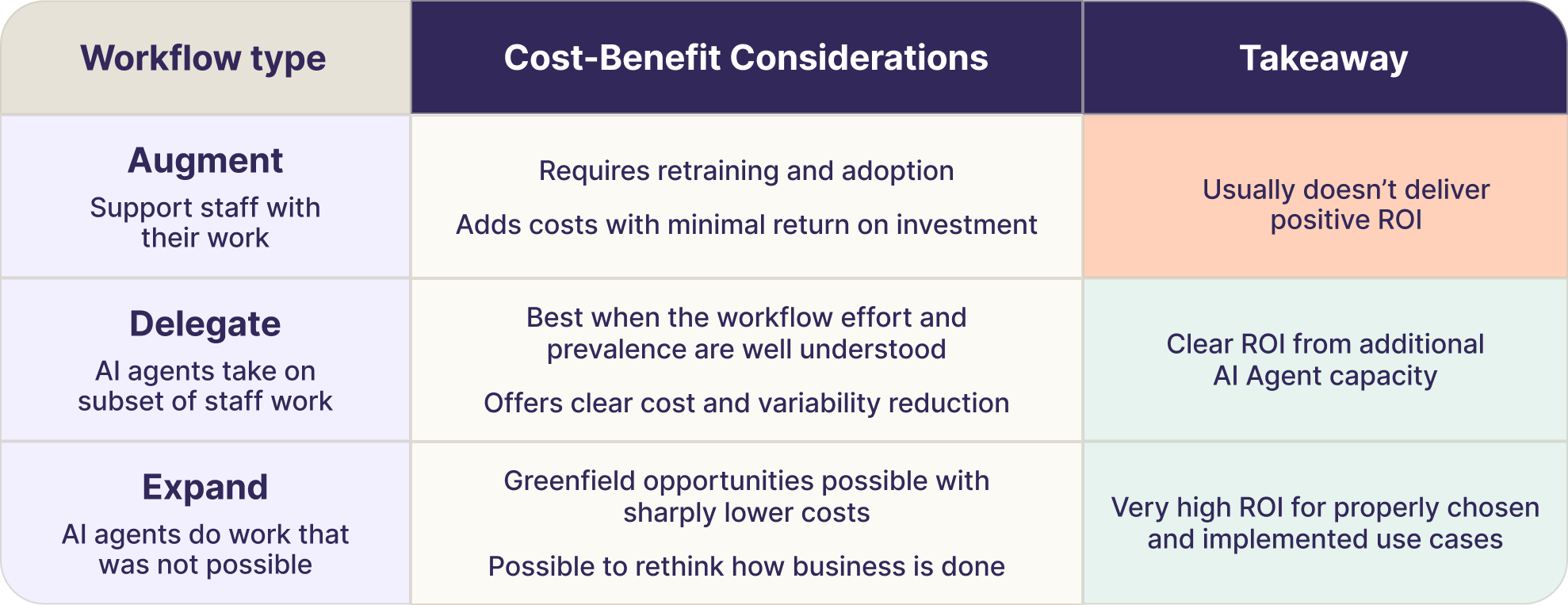
- Augment: You might automate suggestions to agents in real-time, similar to how a manager sits shoulder-to-shoulder with a staff member during onboarding. It doesn't decrease cost because the agent still does the work and you pay for the solution. It requires retraining and adoption, adds cost with minimal return, and usually doesn't deliver positive ROI.
- Delegate: The business case relies on reducing costs or reallocating resources to higher-value tasks while AI agents handle repetitive, automatable work. It works best when workflow effort and prevalence are well understood, offers clear cost and variability reduction, and delivers clear ROI from additional AI agent capacity.
- Expand: Because this is net-new work, it usually requires a new revenue case or process redesign. Examples include automated outbound calling to patients with open orders, patients the health system couldn't reach with text or portal messages and didn't have the human capacity to call given that 70% of calls go to voicemail. Greenfield opportunities are possible with sharply lower costs and very high ROI for properly chosen use cases.
Step 3: Evaluate workflows
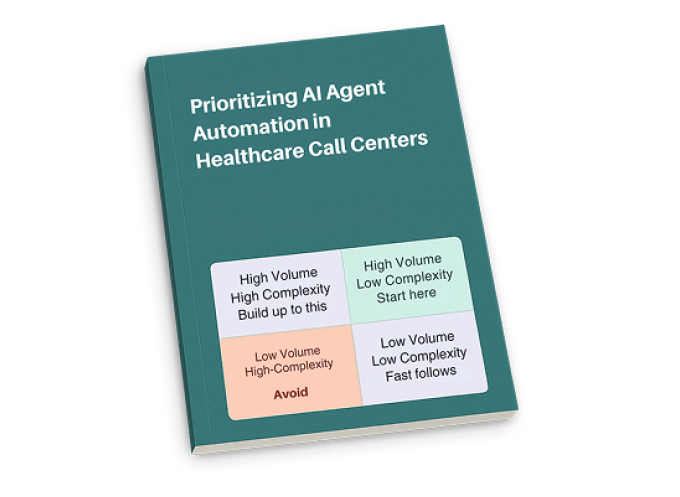
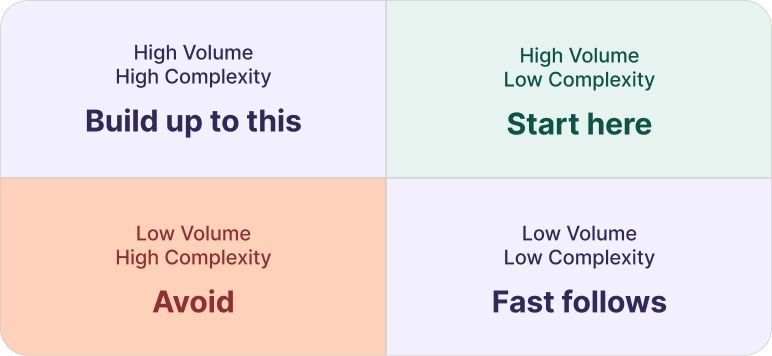
Having understood the sources of value and the workflow types that are the best fit for the organization, it's time to prioritize and sequence individual workflows. Create a list of these workflows and score them based on their complexity and volume.
- Complexity is driven by integrations with systems of record like EMRs and CRMs (tip: if possible, use flat file exchange via SFTP to avoid system integration where a real-time connection isn't required) and the number of steps in the workflow. Increasing process complexity makes it harder for both AI agents to execute tasks correctly and for patients to complete required actions.
- Volume is driven by the number of tasks that can be automated over a year and the average duration of each task. Longer tasks create more value when automated.
Step 4: Start with the quick wins
Change in an organization is challenging. AI agents are powerful but not perfect. Starting with lower-complexity, fast-to-implement use cases shows the organization this can work and creates buy-in for more complex EMR integrations.
AI Task Examples
By now it should be clear that you'll want to start with Delegate and Expand workflows that deliver clear cost savings and revenue opportunities by automating use cases that combine high volume with low-to-medium complexity. Two examples we've found to be successful places to start:
- Delegate – Hospital call routing: AI agents answer the phone at hospitals and handle all the "switchboard work" of connecting callers to the desired department, service line, or provider office. They also manage lower-volume, low-complexity workflows like password resets and answering health-system questions from the website or a curated FAQ set. This can start as small as a single hospital and requires no EHR integration. The system deflects over 75% of incoming calls, including spam, freeing operators for higher-value work.
- Expand – Outbound calling for patients with open orders: AI agents automatically call patients with open orders and encourage them to schedule (e.g., mammography screenings or specialist visits), transferring qualified patients to the scheduling team. This can start as small as a single service line and avoids lengthy EHR integration by exchanging flat files over SFTP. Instead of wasting 85% of calls on uninterested patients, your team spends 100% of their time with patients who actively want appointments.